
















- Free 1-3 Day FedEx Shipping
- 30-Day Trial, No Restocking Fees
- Low Price Guarantee
- Authorized Dealer


A lumpy pool floor will not stop a good robot, but it will expose a bad match. Here is what rides over bumps, and what you should fix first.
The Quick Answer
Buy the Dolphin Sigma for an uneven in-ground floor: tracks to ride over the bumps and a gyroscope to re-orient when a dip tips it. The Dolphin Quantum is the runner-up, lighter and lower-priced, on continuous rubber tracks. If your pool is above-ground with a soft sand base, skip both and buy the Dolphin Cayman.
See All 5 PicksFew pool floors are as flat as they look. Vinyl bottoms settle and wash out, above-ground pools carry the footprints of everyone who stood on the sand base, liners wrinkle, plaster heaves or gets patched, and old drains sit proud of the surface. If that is your pool, the best robotic pool cleaner for uneven floors is one that keeps its footing and its sense of direction when the ground stops cooperating.
The basic equipment is the same on every Dolphin here: tracks, which ride over unevenness better than wheels do. What differs is weight, navigation and where each robot is allowed to work. A robot can still stall in a deep divot or behind a big wrinkle, and no robot levels a floor. The Premier and the Clear S round out the list for in-ground pools.
Our Top Picks for Uneven Floors
Ranked for this job, with today's price on each. We sell every robot on this list.
-
Top Pick

Best Recovery When the Floor Tips It
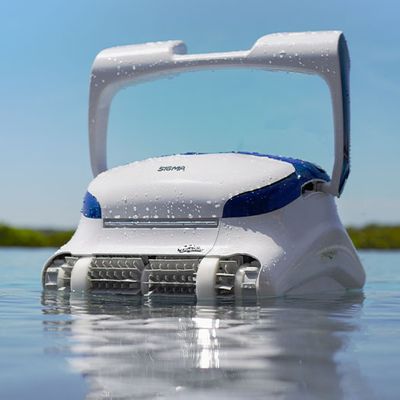
Dolphin Sigma
On a rough in-ground floor the Sigma has the best answer to the moment a bump throws a robot off: SmartNav 3.0 with an onboard gyroscope, which re-orients it after being tipped instead of letting it wander. HyperGrip tracks and three ProLine motors give it the drive to pull through a shallow low spot, and quad scrubbing brushes reach into the dips where silt settles. It is the heaviest Dolphin here at 24.6 lb, which is fine on plaster or a firm vinyl floor and wrong for a soft base.
- Good Fit
- Buy this if your in-ground floor is heaved, patched or settled and other robots have lost their way on it.
- Think Twice
- Skip this if the pool is above-ground or the base is soft. It is an in-ground robot and the highest-priced pick here.
-
#2
Lightest 50 Ft Dolphin, on Rubber Tracks
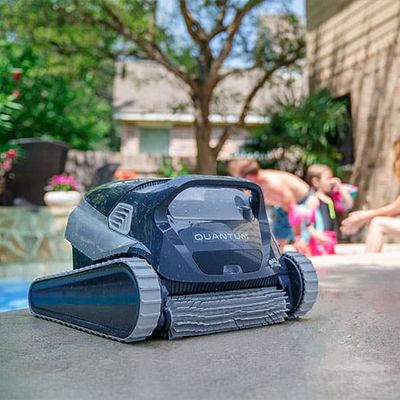
Dolphin Quantum
The Quantum runs on HyperGrip continuous rubber tracks and weighs 18.3 lb, the lightest of the three 50 ft Dolphins, which helps on a settled vinyl bottom. Its SmartNav 2.0 is described as sensing ladders and drains, so a raised old drain cover is the kind of obstacle it is meant to notice, and the dual HyperBrush spins at twice the speed of standard brushes to scrub into shallow dips. With no tilt sensor, it relies on a full 2-hour cycle to even out coverage.
- Good Fit
- Buy this if you have an in-ground vinyl or plaster pool up to 50 ft with ordinary waves and dips.
- Think Twice
- Skip this if your pool is above-ground. The 2-hour cycle and 2-year warranty are the trade for the lower price.
-
#3
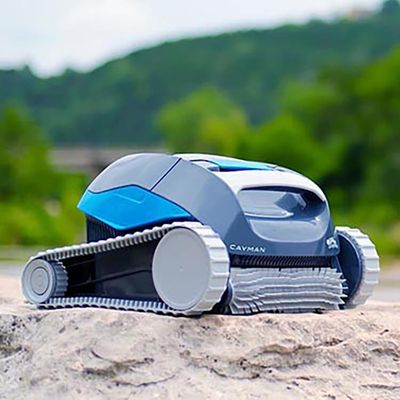

Best for Soft Above-Ground Bases
Dolphin Cayman
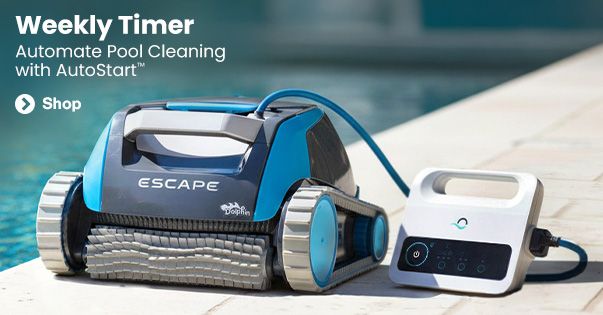
The Cayman is the pick when the floor is uneven because the base under it is soft. At 14.6 lb it presses far less on a sand base than the 50 ft Dolphins would, and it is rated for above-ground as well as in-ground pools up to 33 ft. HyperGrip tracks carry it over footprints and small divots, and vinyl liner is on its published surface list. The Escape, at 14.2 lb, is the other above-ground option and costs less. A longer 50 ft cable and a daily timer are why this one gets the spot.
- Good Fit
- Buy this if you have an above-ground pool or a small in-ground vinyl pool with footprints and soft spots.
- Think Twice
- Skip this if the pool is longer than 33 ft. It cleans floor and walls only, and its cable has no swivel.
-
#4
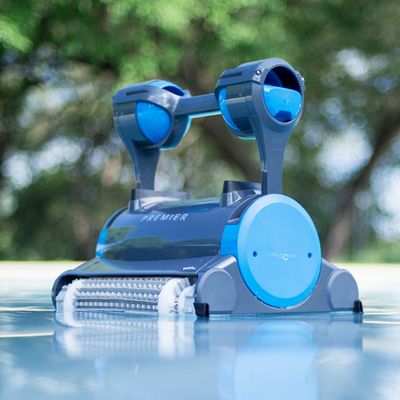
Best Long Cycle for Debris in the Low Spots
Dolphin Premier
The Premier takes on an uneven floor with persistence. It has HyperGrip tracks, dual ProLine motors moving 4,500 GPH and a 3-hour cycle, the longest of the Dolphins here, so a low spot it skimmed on one pass gets another visit later. That matters because dips are where leaves and silt collect, and the Multi-Media system lets you match the filter to whatever is in them. It ranks fourth because it has no tilt sensor and weighs 20.3 lb.
- Good Fit
- Buy this if debris collects in the low spots of a large in-ground pool and you want a simple timer.
- Think Twice
- Skip this if the floor is badly out of level. A longer cycle helps coverage, but it will not free a robot from a deep divot.
-
#5
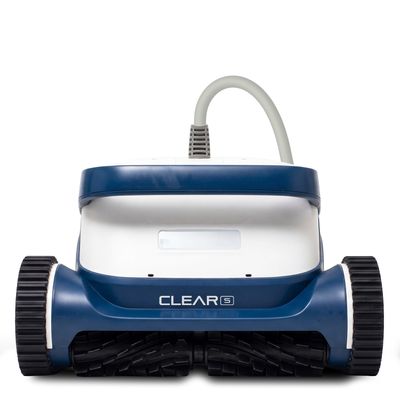
Sensor Navigation and High Flow for Dips
Clear S
The Clear S earns a place for two things an uneven floor rewards. A gyroscope and accelerometer guide it, with coverage tightening after two or three cycles, and its 8,500+ GPH is the highest flow in this guide, which helps lift settled silt out of dips. Front and rear active scrubbing brushes work in both directions. It is fifth because its strengths are navigation and flow, while the Dolphins' case on rough ground rests on tracks and weight. It is rated for in-ground pools up to 50 ft.
- Good Fit
- Buy this if silt settles in the low spots of an in-ground pool and you want app control with schedules.
- Think Twice
- Skip this if any low or shallow area holds less than 2.5 ft of water, its minimum working depth.

What Matters on an Uneven Floor
-
Tracks Over Bumps
A track spans a small dip or ridge where a wheel would drop into it. Every Dolphin on this page runs on HyperGrip tracks, so the starting point is good across the range.
-
Weight on a Soft Base
Above-ground pools sit on sand or foam under a thin liner, and a lighter robot is kinder to that base. The Cayman weighs 14.6 lb and the Escape 14.2 lb. The 50 ft Dolphins run from 18.3 lb to 24.6 lb and are in-ground robots in any case.
-
Recovering After a Tip
Bumps tilt a robot and can turn it off its line. The Sigma's onboard gyroscope senses the change and re-orients. The Clear S has a gyroscope and accelerometer. The other picks use SmartNav 2.0 scanning and sort themselves out over the cycle.
-
The Size of the Defect
Shallow footprints, gentle waves and small ridges are routine. A divot deep enough to cradle the robot, or a wrinkle tall enough to act as a curb, is a floor problem and not a robot problem.
Uneven-Floor Specs Compared
Published specs for the picks above, with today's price.
| Specification | Dolphin Sigma | Dolphin Quantum | Dolphin Cayman | Dolphin Premier | Clear S |
|---|---|---|---|---|---|
| Price Today | $2349 | $1599 | $1049 | $1949 | $1749 |
| Cleans | Floor, walls and waterline | Floor, walls, waterline, sun shelves and stairs | Floor and walls | Floor, walls and waterline | Floor, walls and waterline |
| Traction | HyperGrip tracks | HyperGrip tracks | HyperGrip tracks | HyperGrip tracks | — |
| Navigation | SmartNav 3.0 with gyroscope | SmartNav 2.0 | SmartNav 2.0 | SmartNav 2.0 | Gyroscope and accelerometer |
| Working depth | — | — | — | — | 2.5 to 16.4 ft |
| Cable | 55 ft with 360° anti-tangle swivel | 55 ft with anti-tangle swivel | 50 ft | 55 ft with 360° anti-tangle swivel | 59 ft anti-tangle |
| Robot weight | 24.6 lb | 18.3 lb | 14.6 lb | 20.3 lb | — |
| Warranty | 3 years | 2 years | 2 years | 3 years | 3 years (limited) |
| Shop | Shop the Sigma | Shop the Quantum | Shop the Cayman | Shop the Premier | Shop the Clear S |
What to Fix Before You Buy a Robot
A robot cleans the floor you have. It does not improve it, and a few defects are worth fixing first because they will stop any machine.
- Large liner wrinkles. A fold tall enough to pinch between your fingers can catch a track. A liner professional can often work bad ones out.
- Deep divots and washouts. A hollow big enough to cradle the robot will hold it. In an above-ground pool the real cure is re-leveling the base the next time the liner is changed.
- Raised or loose drain covers and fittings. Anything that rocks or sits high should be secured or replaced.
- Lifting or blistered patches. Loose plaster sheds grit into the filter every cycle and can snag a brush, so repair it.
How a Robot Behaves on a Lumpy Floor
Expect three things. First, the robot will rock and change direction more than it would on a flat floor. That is fine, because coverage comes from the whole cycle, not from neat lines. Second, debris keeps settling in the low spots between cycles, so those areas gain more from frequent runs than from one long one. Third, an occasional stall is normal. If the robot stops in the same place every cycle, look at the floor there: it is showing you the worst divot or wrinkle.
On a soft above-ground base, keep to the two light robots, the Cayman or the Escape, and avoid standing in one spot on the floor yourself. Footprints are how many of those divots got there.
Tips for Running a Robot on an Uneven Floor
- Run shorter gaps between cycles if your robot allows it. Low spots refill with silt, so frequent cleaning beats one weekly run.
- Note where the robot stalls. The same spot twice means a divot, wrinkle or raised fitting that deserves a look.
- Keep the filter clean. A loaded filter cuts water flow, and a robot with weak flow grips less and stalls more easily.
- On a liner, check the brushes and tracks for trapped grit before each run so nothing sharp gets dragged across soft vinyl.
Uneven Floor Questions
Will a robot get stuck in a divot or low spot?
In a shallow one, no. Tracks span small dips and the robot drives through. In a hollow deep enough to cradle the whole machine, yes, any robot can stall, and so can one that meets a wrinkle tall enough to act as a curb. If it happens in the same spot every time, the fix is the floor.
Is a lighter robot better for an above-ground pool with a sand base?
Yes. Less weight means less pressure on a base that is only packed sand or foam under a liner. The Cayman at 14.6 lb and the Escape at 14.2 lb are the two robots here made for above-ground pools, and they are also the two lightest Dolphins. The 50 ft robots on this page are for in-ground pools only.
Can a robotic cleaner harm a wrinkled vinyl liner?
Vinyl liner is on the published surface list for every Dolphin on this page, and tracks and brushes are made to run on it. The wrinkle is the concern, not the liner: a robot working at a tall fold cycle after cycle is not doing it any favors.
Will a robot smooth out or level a bumpy pool floor?
No. A robot removes debris and scrubs the surface it is given. It will not flatten footprints, pack a washed-out base or press out a wrinkle. Those are repairs. What the best robotic pool cleaner for uneven floors does is keep cleaning well in spite of them.
My plaster has a raised patch. Will the robot climb over it?
Almost always. A feathered patch or a slightly heaved section is a speed bump to a tracked robot. A patch with a sharp, raised edge is different: it can catch a brush or a track and wear both over time, so have the edge ground down.
Still have questions? Browse our pool robot troubleshooting guides, contact our pool experts, or call (888) 615-5728

Our Verdict on Uneven Floors
Start with the floor, then the robot. Fix tall wrinkles and deep divots, because nothing drives out of those. For an uneven in-ground floor, buy the Sigma for its gyroscope, or the Quantum to spend less. For an above-ground pool or a soft base, buy the Cayman and nothing heavier. The Premier and the Clear S suit in-ground pools where debris settling in low spots is the real complaint. Unsure which you have? Ask our pool experts.

